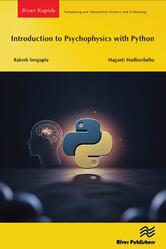
This book presents psychophysics as an irreverent yet rigorous science – a field that challenges past authority by emphasizing reproducibility, quantitative precision, and the empirical basis of perception. Rooted in classical traditions (Weber, Fechner, Stevens), it equips readers with both historical grounding and hands-on methods.
Relation to psychology.
While general psychology investigates behavior and cognition broadly, psychophysics focuses specifically on the interface between the external world (stimulus properties) and the internal world (subjective experience). For instance, while a psychologist might study visual attention or memory, a psychophysicist would examine how small a difference in brightness must be for an observer to reliably detect a change.
This bridge between objective measurements and subjective experiences makes psychophysics foundational for sensory psychology, neuroscience, cognitive science, and even applied fields such as human–computer interaction and visual design.
Contents.
Preface.
Acknowledgements.
Aims and Objectives.
List of Abbreviations.
About the Authors.
1 History of Psychophysics
1.1 Truth and Scientific Method.
1.2 What is Psychophysics?.
1.2.1 Psychophysics in the scientific method
1.2.2 Relation to psychology.
1.3 Why Psychophysics?.
1.4 Timeline of Key Developments.
1.5 Weber’s and Fechner’s Laws.
1.5.1 Weber’s law.
1.5.2 Fechner’s Law.
1.6. Experimental Paradigms: A Brightness JND Example.
1.6.1. Method of limits.
1.6.2. Method of constant stimuli.
1.6.3. Method of adjustment.
1.6.4. Comparing the methods.
1.7. Preparing PsychoPy.
1.7.1. Installing PsychoPy via web resources.
1.8. A Simple PsychoPy Brightness JND Experiment.
1.8.1. PsychoPy script.
1.8.2. Analysis in Google Colab: Step by step explanation.
1.9. Conclusion.
1.10. Exercises: History of Psychophysics.
1.11. Further Reading.
2 Understanding Sensory Systems
2.1. Introduction.
2.1.1. Sensory modalities and their functions.
2.2. Sensation vs. Perception.
2.2.1. Clinical relevance.
2.3. Vision.
2.3.1. Anatomy and optics of the eye.
2.3.2. Dual visual pathways.
2.3.3. Visual psychophysics paradigms.
2.4. Audition.
2.4.1. Anatomy of the ear.
2.4.2. Sound localization cues.
2.4.3. Auditory psychophysics paradigms.
2.5. Touch (Somatosensation).
2.5.1. Anatomy and receptor types.
2.5.2. Neural pathways.
2.5.3. Key psychophysical paradigms.
2.5.4. Examples and applications.
2.6. Taste (Gustation).
2.6.1. Anatomy and receptor mechanisms.
2.6.2. Neural pathway.
2.6.3. Key psychophysical paradigms.
2.6.4. Examples and applications.
2.7. Smell (olfaction).
2.7.1. Anatomy and receptor mechanisms.
2.7.2. Neural pathways.
2.7.3. Key psychophysical paradigms.
2.7.4. Examples and applications.
2.8. Psychophysics and Developmental Psychology.
2.8.1. Historical foundations: The work of Robert Fantz.
2.8.2. Infant looking paradigms in psychophysical research.
2.8.3. Technological advances in infant looking studies.
2.9. Example PsychoPy Experiment: A Working Memory Sequence-Judgement Task.
2.9.1. Experiment code.
2.9.2. Running the experiment.
2.9.3. Data analysis in Google Colab.
2.10. Student Exercises.
2.11. Additional Reading.
3 Signal Detection Theory and Experimental Design
3.1. Introduction to Psychophysical Methods.
3.1.1. The scientific method in psychophysics.
3.1.2. Experimental variables.
3.1.3. Validity and reliability.
3.1.4. Key concept: Counterbalancing and randomization.
3.1.5. Applying psychophysical principles to the serial memory experiment.
3.2. Experimental Design Principles.
3.2.1. Behveen-subjects vs. within-subjects designs.
3.2.2. Sampling methods and power analysis.
3.2.3. Common experimental pitfalls.
3.3. Signal Detection Theory (SDT).
3.3.1. Core concepts of signal detection theory.
3.3.2. SDT distributions.
3.3.3. ROC curves.
3.3.4. Applying SDT to the brightness discrimination task.
3.3.5. Applications of SDT in psychophysics.
3.4. Statistical Analysis Framework.
3.4.1. Parametric tests.
3.4.2. Non-parametric tests.
3.4.3. Multiple comparisons problem.
3.5. Psychometric Functions.
3.5.1. Curve fitting methods.
3.5.2. Threshold estimation.
3.5.3. Applications of psychometric functions.
3.6. Student Exercises.
3.7. Recommended Reading.
4 Using PsychoPy to Build Experiments
4.1. Getting Started with PsychoPy.
4.2. Example 1: Brightness JND Experiment.
4.2.1. Design and psychophysical rationale.
4.2.2. Step-by-step explanation of the brightness JND script.
4.2.3. Data analysis for brightness JND.
4.3. Exercise: Building a Serial Memory (Primacy/Recency) Experiment.
4.3.1. Serial position profiles.
4.4. Best Practices, Debugging, and Reproducibility.
4.5. Running Experiments Remotely or in the Lab.
4.6. Conclusion.
Answer Keys.
Bibliography.
Index.
Бесплатно скачать электронную книгу в удобном формате, смотреть и читать:
Скачать книгу Introduction to Psychophysics with Python, Sengupta R., Madhavilatha M., 2026 - fileskachat.com, быстрое и бесплатное скачивание.
Скачать pdf
Ниже можно купить эту книгу, если она есть в продаже, и похожие книги по лучшей цене со скидкой с доставкой по всей России.Купить книги
Скачать - pdf - Яндекс.Диск.
Дата публикации:
Теги: учебник по программированию :: программирование :: Sengupta :: Madhavilatha
Смотрите также учебники, книги и учебные материалы:


Следующие учебники и книги:


Предыдущие статьи: