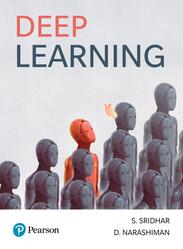
Deep Learning, Sridhar S., Narashiman D.
Deep Learning is designed to be a textbook for undergraduate and postgraduate students. Many Indian universities have started giving UG courses in Artificial Intelligence, Machine Learning, and Data Science. This book would be helpful for computer science and IT students who specialize in these degrees. The book aims to provide basics like artificial intelligence, machine learning, natural language processing, image processing, and computer vision that are necessary to understand deep learning technologies. The concepts of basic neural networks are discussed along with activation and loss functions. The concept of optimization and regularization are dealt with in this book.
Artificial Neural Networks and Deep Learning Explained.
Artificial Neural Networks (ANN) is an alternate mechanism for developing intelligent systems. The biological neurons of humans inspire it. The human brain has a network of biological neurons. Biological neurons absorb information, and encountering danger triggers another neuron at a certain point. This process is repeated and finally carried to the human brain, and the brain reacts to danger. Artificial Neural Networks (ANN) create mathematical models equivalent to biological neurons.
Deep learning is the “family of algorithms using ANN structures with two or more hidden layers.” By ‘Deep’ means the depth of the neural networks, defined as the number of levels of the composition of non-linear operations.
Contents.
Cover.
About Pearson.
Title Page.
Table of Contents Preface.
About the Authors Acknowledgments List of Reviewers.
Introduction to Deep Learning.
2. Introduction to Artificial Neural Networks.
3. Introduction to Activation and Loss Functions.
4. Introduction to Optimization.
5. Introduction to Regularization.
6. Understanding Data.
7. Introduction to Regression and Classification.
8. Introduction to Computer Vision and Image Processing.
9. Convolutional Neural Networks.
10. Transfer Learning.
11. Introduction to Object Detection.
12. Recurrent Neural Networks.
13. Introduction To Autoencoders.
14. Natural Language Processing for Deep Learning.
15. Transformer Architecture and Large Language Models.
16. Generative Al and Generative Adversarial Networks.
17. Boltzmann Machines and Deep Belief Networks.
18. Deep Reinforcement Learning.
Appendix A: Installation of Keras.
Appendix B: Keras Programming.
Appendix C: Lab Manual.
Bibliography.
Index.
Copyright.
Ниже можно купить эту книгу, если она есть в продаже, и похожие книги по лучшей цене со скидкой с доставкой по всей России.Купить книги
Купить .
Дата публикации:
Теги: учебник по информатике :: информатика :: компьютеры :: Sridhar :: Narashiman
Смотрите также учебники, книги и учебные материалы:


Следующие учебники и книги:


Предыдущие статьи: