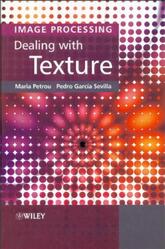
Texture is all around us, and texture is also on the images we create. Just as variation in what we do allows us to distinguish one day in our life from another, texture allows us to identify what we see. And if texture allows us to distinguish the objects around us, it cannot be ignored by any automatic system for vision. Thus, texture becomes a major part of Image Processing, around which we can build the main core of Image Processing research achievements.
This book is exactly trying to do this: it uses texture as the motivation to present some of the most important topics of Image Processing that have preoccupied the Image Processing research community in the recent years. The book covers the topics which have already been well established in Image Processing research and it has an important ambition: it tries to cover them in depth and be self-contained so that the reader does not need to open other books to understand them.
How can we estimate some aggregate parameters of the 2D Boolean model?
Some useful aggregate parameters of a Boolean texture are the area fraction /, the specific boundary length L, and the specific convexity N+. There are many more aggregate parameters that may be defined, but we chose these particular ones because they are useful in estimating some of the basic individual parameters of the underlying Boolean model, in the case when the grains are assumed to be convex shapes and the germ process is assumed to be Poisson.
The area fraction / is defined as the ratio of the black (covered) pixels over all pixels in the image. For example, in the image of figure 2.19a this parameter is / = 0.38 because there are 38 black pixels and the image consists of 100 pixels.
Contents.
Preface.
1. Introduction.
2. Binary textures
2.1. Shape grammars.
2.2. Boolean models.
2.3. Mathematical morphology.
3. Stationary grey texture images.
3.1. Image binarisation.
3.2. Grey scale mathematical morphology.
3.3. Fractals.
3.4. Markov random fields.
3.5. Gibbs distributions.
3.6. The autocorrelation function as a texture descriptor.
3.7. Texture features from the Fourier transform.
3.8. Co-occurrence matrices.
4. Non-stationary grey texture images.
4.1. The uncertainty principle and its implications in signal and image processing.
4.2. Gabor functions.
4.3. Prolate spheroidal sequence functions.
4.4. Wavelets.
4.5. Where Image Processing and Pattern Recognition meet.
4.6. Laws’ masks and the “what looks like where” space.
4.7. Local binary patterns.
4.8. The Wigner distribution.
Bibliographical notes.
References.
Index.
Бесплатно скачать электронную книгу в удобном формате, смотреть и читать:
Скачать книгу Image Processing Dealing with Texture, Petrou M., 2006 - fileskachat.com, быстрое и бесплатное скачивание.
Скачать djvu
Ниже можно купить эту книгу, если она есть в продаже, и похожие книги по лучшей цене со скидкой с доставкой по всей России.Купить книги
Скачать - djvu - Яндекс.Диск.
Дата публикации:
Теги: учебник по информатике :: информатика :: компьютеры :: Petrou
Смотрите также учебники, книги и учебные материалы:

Предыдущие статьи: